Banks and lenders
Review public product pages, fee information and application guidance alongside the conditions that explain who a service is for.

Tityra audits finance and insurance content for better Agent Experience (AX). Get documented findings and practical recommendations.
Check the information a tested client receives.
Review fees, exclusions and supporting context.
Plan content and delivery work using the evidence.
Financial Services & Insurance
A product page may show its main benefit while fees, eligibility conditions or exclusions appear elsewhere. If a retrieval tool misses that supporting information, it receives an incomplete description. Review what your website delivers and whether the important conditions remain connected to the product they explain.
Review public product pages, fee information and application guidance alongside the conditions that explain who a service is for.
Assess how policy summaries, exclusions and supporting documents are delivered across selected insurance pages.
Examine public pricing explanations, service information and help resources, with attention to the limits and requirements described on each page.
Give publishing, product and web development colleagues evidence of issues in the delivery and structure of financial information.
What we review
An audit examines the agreed pages and checks under recorded conditions. Findings describe what was observed, with supporting evidence and recommended changes, without assuming that every AI retrieval tool receives or interprets the same information.
Where included in the agreed checks, compare the initial HTML with the rendered page. Look for important terms or explanations that appear only after JavaScript runs or a visitor opens an interactive element.
Review page links, metadata and structured data within the agreed scope. Identify missing or inconsistent signals that make product pages and their supporting resources harder to discover or describe.
Examine headings, lists, tables and links, including relevant accessibility signals. Check whether labels and relationships preserve the meaning of fee tables, comparison content and application instructions.
Look for eligibility details, exclusions, dates and links to relevant documents. Flag missing or unclear context without validating rates, judging product suitability or interpreting financial regulations.
Where AX fits
These examples describe possible assessment scopes. Start with representative public pages and agree which content and checks will answer your team's question.
Review selected product pages with their published fee explanations and eligibility conditions. Investigate whether a client can retrieve the details needed to understand the description.
Examine how policy summaries connect to exclusions and supporting wording. Record delivery or structure issues that can separate a coverage statement from the conditions published alongside it.
Assess the availability and context of public risk disclosures, application instructions and required-document lists. Check the relevant dates and document relationships within the agreed sample.
Review a separately authorised sample across product lines or brands. Distinguish content that needs a local correction from a shared template or delivery issue affecting several pages.
Inside the report
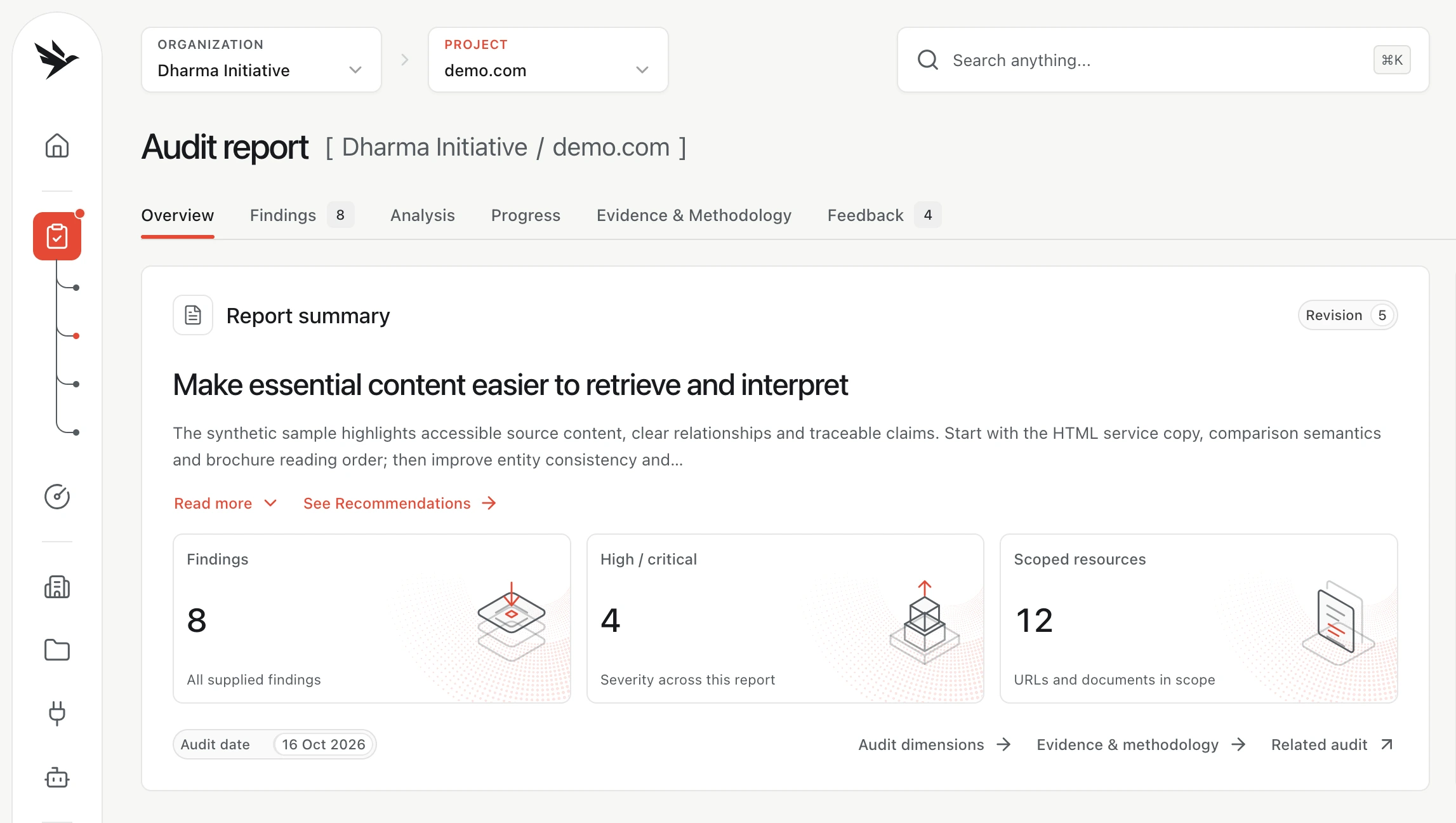
Review the affected pages, evidence and recommendations in one report. Use the findings to decide which publishing or engineering changes your team should investigate first.
Read the audit methodologySee the pages involved, the severity of each finding and the content included in the assessment.
Review the recorded response or page behaviour. Keep the observation distinct from a possible effect on another retrieval tool.
Identify content corrections, template investigations or changes to delivery, with the evidence available to the team carrying out the work.
Keep the original findings available when reviewing a change. Request a new audit when a subsequent assessment of the website is needed.
Keep the work connected
Organise websites into projects within the relevant organisation. Colleagues use their own accounts, with access governed by their membership and permissions in each workspace.
Explore your workspaceCreate an account and an organisation for your business. If you manage separate businesses, the same account can belong to multiple organisations, with a separate membership and role in each.
A member with project-creation permission creates a project for each website. Each project has its own audit requests, subject to website authority, the agreed scope and any required credit approval.
Once a report is released, authorised colleagues can review findings, evidence and recommendations. Members with write access can record remediation progress, then request a new audit after changes when appropriate.
Weekly monitoring automates In-Depth Audits for enabled projects on every workspace plan. Each run uses organisation credits against your approved page budget, up to 100 pages. Pause or resume projects individually.
Weekly reports are delivered after the required checks and credit settlement. Subscription fees and audit credits are separate; Expert Review needs its own approved scope and credit budget.
Set up monitoring
Free workspace
Initial Audit: Free
Up to 10 pages
per month, excluding VAT
5 In-Depth Audits / month
Up to 100 pages per audit
per month, excluding VAT
20 In-Depth Audits / month
Up to 100 pages per audit
Choose an agreed sample of public product pages and the resources needed to understand them, such as fee information, eligibility conditions, exclusions or application guidance. Create an account to request an audit or contact our team to discuss the scope. You must be authorised to have the website assessed.
No. A website content audit examines the agreed delivery, structure and context checks. It does not provide financial advice, interpret regulations, certify compliance or assess whether a product is suitable for a particular customer.
The assessment can identify whether published information is available and how it is structured or connected to supporting context. It does not verify the commercial accuracy of a rate, calculate product costs, validate policy coverage or replace your product and legal review processes.
No. The report documents observed website behaviour and content issues under the agreed checks. Tityra cannot control which sources another AI system retrieves or how it uses them, and cannot guarantee answers, citations or rankings.
Start with public information you are authorised to have reviewed. The website content audit is not an assessment of banking systems, payment processing or account security. Contact us before proposing restricted resources, and do not send credentials, account details or private customer records with an enquiry.
Review the recommendations with the colleagues responsible for the content and website, then record remediation progress alongside the findings. Request a new audit when you need a subsequent assessment; recording a change does not automatically verify that it resolves the original issue.
By clicking “Accept all cookies”, you agree to the storing of optional analytics cookies on your device to help us understand site usage and improve our website. You may click the customise button to choose which optional cookies you would like to allow.
We save your cookie choice in this browser for six months, so you do not have to choose on every visit. This storage is always on.
tityra_analytics_consent_v1Remembers whether you accepted or rejected analytics. Your choice is valid for 180 days (six months), after which we ask again. The stored record remains until it is replaced or you clear your browser storage.
tityra_analytics_consent_v1_refusalKeeps analytics off if your browser cannot save a rejection in local storage. This fallback is only used when needed and is cleared when a subsequent choice is successfully saved.
Google Analytics helps us understand page visits, content engagement, interest in audit packages and account signup link clicks. It only loads after you accept. Advertising features are disabled.
_gaDistinguishes visitors to help us understand how the website is used. Set only after you accept analytics; advertising features are disabled.
_ga_*Maintains analytics session information, such as visits and interactions with the website. Set only after you accept analytics. The asterisk represents the identifier in the cookie name.
You control whether optional analytics runs on this website. We remember your choice for six months, and you can change it at any time using Cookie preferences in the footer.
Rejecting or withdrawing consent stops analytics and removes the Google Analytics cookies this website can access.
The details list the name, provider, purpose, type and storage duration of each entry. Contact details and private account information are not included in website analytics.
Counts describe the entries listed, including the fallback and cookie name pattern, rather than cookies currently stored on your device.
Read our cookie information